



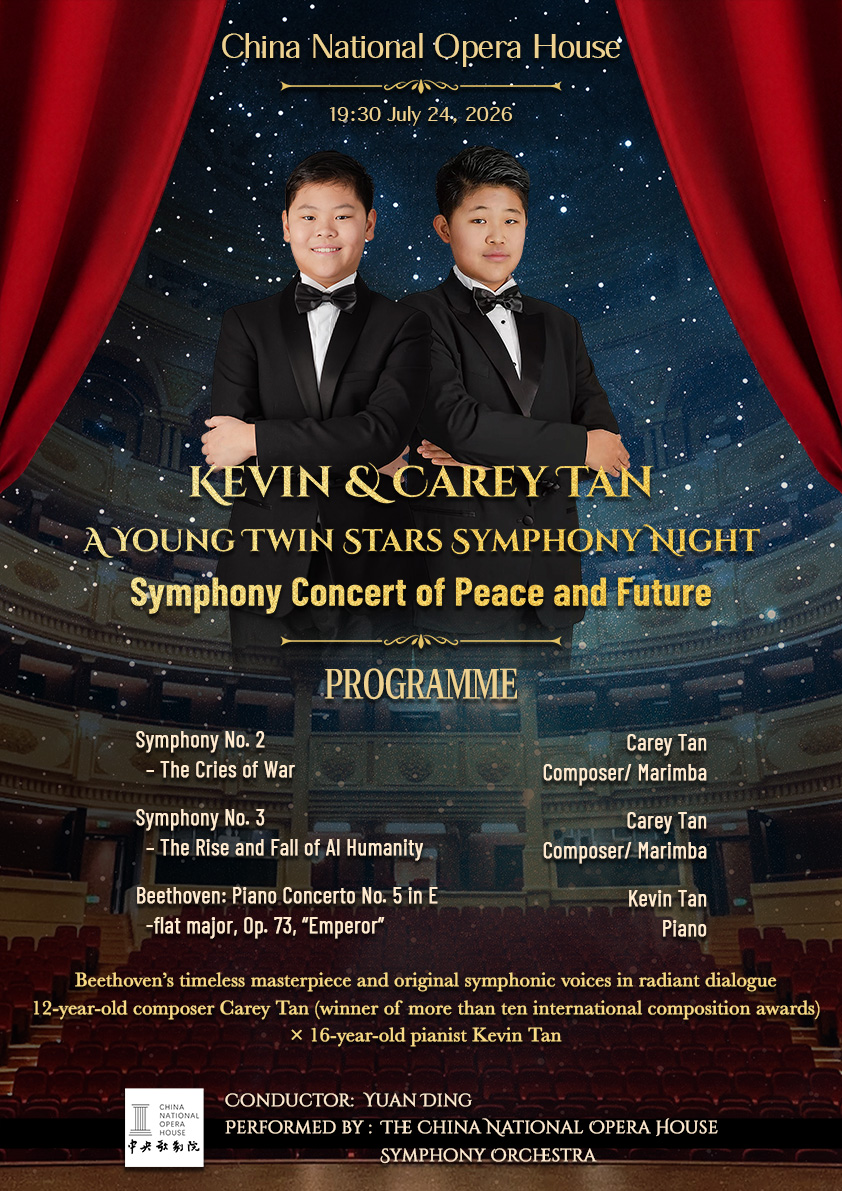
Beethoven’s timeless masterpiece and original symphonic voices in radiant dialogue
12-year-old composer Carey Tan (winner of more than ten international composition awards) × 16-year-old pianist Kevin Tan
Conductor: Yuan Ding
Performed by the China National Opera House Symphony Orchestra
China National Opera House
19:30 July 24, 2026
An Extraordinary Encounter of Peace, Future, and Musical Imagination
Symphony Concert of Peace and Future brings together the China National Opera House Symphony Orchestra with brothers Kevin Tan and Carey Tan for an evening of symphonic music marked by intellectual depth, artistic intensity, and a strong sense of our time.
At the heart of the concert are two original symphonic works by 12-year-old composer Carey Tan: The Cries of War and The Rise and Fall of AI Humanity. As a young composer attracting increasing international attention in the classical music world, Carey Tan has already won more than ten international composition awards. His music reveals a maturity far beyond his years, distinguished by large-scale architectural thinking, vivid orchestral colour, clear musical logic, and a profound engagement with contemporary concerns.
The Cries of War traces a spiritual arc through suffering, reflection, and reconciliation, giving voice to humanity’s enduring longing for peace. The Rise and Fall of AI Humanity turns to the emergence, expansion, imbalance, and collapse of an AI-shaped civilisation, offering a musical meditation on technological development and the future destiny of humankind. Together, these two works form the thematic core of the evening: peace and future. In this sense, the concert is not only a musical event, but also an artistic response to some of the defining questions of our age.
The second half of the programme features Beethoven’s Piano Concerto No. 5 in E-flat major, Op. 73, “Emperor,” performed by 16-year-old pianist Kevin Tan. In its grandeur and brilliance, this immortal masterpiece embodies the radiance, strength, and dignity of the classical spirit. With Beethoven’s enduring voice placed alongside newly composed symphonic works, the concert unfolds as a profound dialogue between historical resonance and future imagination.
This is an evening of music, ideas, and contemporary meaning. Audiences will not only hear a great classic renewed in performance, but also witness how a new generation of musical voices speaks within the cultural language of our time.
Artists
Kevin Tan — Piano
Kevin Tan is a young pianist active on the international stage, with a concerto repertoire that includes Beethoven, Rachmaninoff, and major works from the Romantic tradition. He has received prizes in numerous international piano competitions and is widely recognised for his exceptional technical command, mature musical understanding, and compelling stage presence.
In recent years, he has toured in the United Kingdom, China, Germany, Austria, Norway, Romania, and the Czech Republic, giving more than thirty solo and concerto performances. He has appeared in world-renowned venues such as the Berlin Philharmonie and the Musikverein in Vienna, and has collaborated with several European symphony orchestras.
His playing combines power, sensitivity, and emotional intensity, drawing listeners naturally into the breath and pulse of the music. In his interpretations, melody is not merely presented with precision, but endowed with vivid expressive life, revealing an artistic maturity and communicative force of remarkable distinction.
Carey Tan — Composer · Marimba
Carey Tan is a young composer who has attracted significant attention in the international classical music world. His symphonic works have won twelve international composition awards. At the age of eleven, he became one of the youngest composers in British history to earn a university diploma in composition. His large-scale orchestral works have been performed in major European concert halls, including the Berlin Philharmonie and the Musikverein in Vienna, where he has begun to establish a distinctive voice on the international stage.
His work is deeply engaged with major questions of the contemporary world — war and peace, technological transformation, and the future of human civilisation — and approaches them with a maturity of vision far beyond his years. In his compositions, he integrates perspectives from philosophy, physics, and mathematics, creating music whose structures, logic, and sound world are marked by clarity and originality. This interdisciplinary approach allows his symphonic language to remain rooted in tradition while simultaneously expressing a vivid contemporary spirit and intellectual depth.
He is not only the composer of his works, but also one of their key interpreters. As both pianist and percussionist, he takes part directly in performance, uniting composition and execution on stage so that the music reaches audiences with immediacy and vitality. What listeners encounter is not only the work itself, but the living presence of the composer’s own sound and thought.
Yuan Ding — Conductor
Yuan Ding is one of China’s important conductors active in opera and symphonic music. He has worked extensively with leading opera companies and orchestras in China, building a rich body of experience across opera, symphonic repertoire, and major stage productions. He is widely respected for his clear grasp of musical structure, rigorous artistic discipline, and strongly communicative command in performance.
In this concert, Yuan Ding will lead the China National Opera House Symphony Orchestra in shaping the spiritual continuity between Beethoven’s classical concerto masterpiece and Carey Tan’s original symphonic works, creating a unified and compelling artistic whole in which tradition and new voices meet on the same stage.
China National Opera House Symphony Orchestra
The China National Opera House Symphony Orchestra is one of China’s important professional orchestras. Long active in opera, symphonic music, and major national artistic productions, it has developed deep experience in both the interpretation of Chinese and Western classics and the presentation of contemporary works. The orchestra is widely admired for its artistic rigour, rich stage experience, and outstanding ensemble quality.
In this concert, under the baton of Yuan Ding, the orchestra will join two young musicians in presenting a symphonic evening that bridges classic and contemporary expression, and links the themes of peace and future.
Programme
Part I
Symphony No. 2 – The Cries of War
Carey Tan, Composer/arimba
I. Shadows of Misery
II. Reflection
III. The Pact
A symphonic meditation on conflict and memory, moving from devastation through reflection towards the possibility of reconciliation.
This work does not merely portray the violence and destruction of war itself, but turns toward the echoes war leaves in the human spirit: loss, wounds, silence, and the longing for understanding and peace that arises after suffering.
The first movement, Shadows of Misery, unfolds in an atmosphere of oppression and sorrow, drawing the listener into a space marked by anguish and rupture. The second movement, Reflection, turns inward, offering a more restrained and contemplative musical language through which memory and self-examination emerge. The final movement, The Pact, does not celebrate victory in any simplistic sense, but instead gestures toward reconciliation, rebuilding, and the fragile yet enduring hope for peace.
Within the framework of this concert’s theme, The Cries of War is not only a work about conflict, but also a profound musical appeal to the value of peace. It reminds us that what deserves to be remembered is not only destruction, but also humanity’s capacity to move toward trust, healing, and hope once again.
Carey Tan: Symphony No. 3 – The Rise and Fall of AI Humanity
Carey Tan, Composer/Marimba
I. Construction of AI Civilisation
II. Dwelling in Reality
III. Nature and the Universe
IV. Collapse and Destruction
V. Ashes and Echoes
A five-movement symphonic narrative exploring technological emergence, expansion, imbalance, and collapse. The work reflects on humanity’s relationship with artificial intelligence and the fragile balance between progress and responsibility.
Through large-scale structural design and a sound world charged with dramatic tension, the symphony imagines a civilisation shaped by artificial intelligence: how it is built, how it expands, how it loses equilibrium, and how it ultimately disintegrates. Rather than offering a simple prediction of the future, the work opens a broader meditation on technological ambition, ethical limits, and the destiny of humankind.
Beginning with Construction of AI Civilisation, the work projects the force of order being established and systems being set into motion. Dwelling in Reality transforms coexistence between artificial intelligence and the human world into a fluid and layered musical space. Nature and the Universe widens the perspective, setting artificial systems against a broader natural and cosmic order. Collapse and Destruction unleashes the consequences of instability and excess, while Ashes and Echoes leaves the listener in a space of resonance, aftermath, and unresolved questioning.
Within the context of this concert, The Rise and Fall of AI Humanity points beyond artificial intelligence itself to a larger question: how humanity, in an age shaped by technology, can understand itself, restrain its powers, and assume responsibility for the future it is creating.
Part II
Beethoven: Piano Concerto No. 5 in E-flat major, Op. 73, “Emperor”
Piano: Kevin Tan
This magnificent concerto combines monumental breadth, structural power, and heroic lyricism, standing as one of the supreme achievements of the classical concerto tradition. The work embodies the resolute and elevated spirit of Beethoven’s music while also radiating a profound and luminous humanity.
In this concert, the Emperor appears not only as an enduring masterwork, but also as a counterpart to the two original symphonic works in the first half, allowing the spiritual force of classical tradition and the reflective edge of contemporary musical thought to shine together in one evening.
Tradition and New Voices Meet Between Peace and Future
With “peace and future” as its central theme, this concert places Beethoven’s masterpiece alongside contemporary original symphonic works, opening a dialogue of tension and depth between tradition and innovation.
In the first half, Carey Tan responds in symphonic language to some of the most urgent concerns of our time: the trauma of war, artificial intelligence, and the future of humanity. In the second half, Beethoven responds through immortal music to the enduring human pursuit of dignity, strength, and light. These two voices, from different eras, meet on one stage and point toward deeper emotional and intellectual dimensions.
On this evening, audiences will hear not only the resonance of a classic, but also the continued growth of a new symphonic voice within the language of the present — a voice that opens further possibilities for imagination, relevance, and artistic expression in the symphonic tradition.